
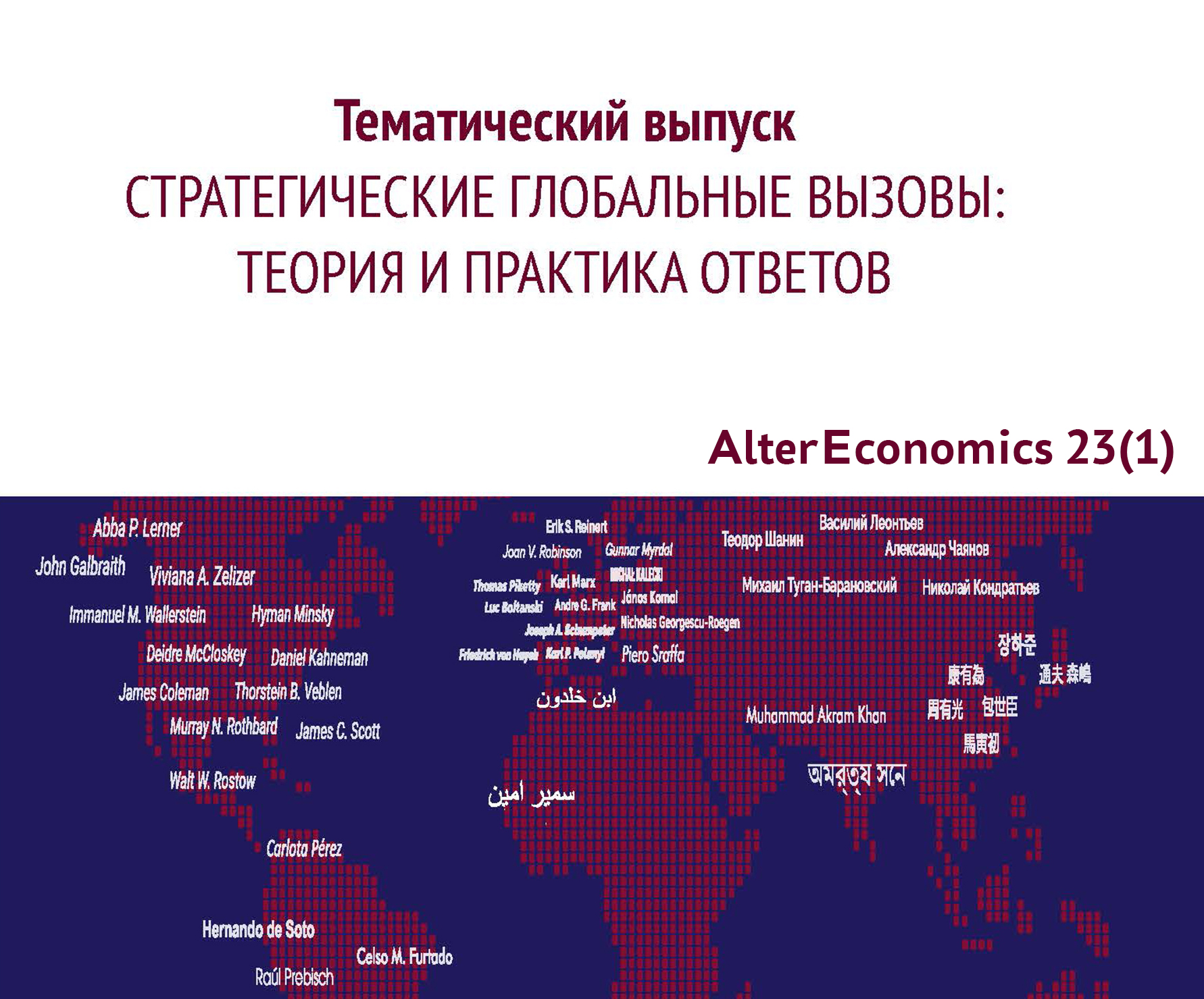
This issue focuses on analyzing fundamental changes in the global economy. Rising geopolitical tensions, technological rivalry among leading powers, and the shifting liberal world order are the causes of these changes.
Edited by E.B. Lenchuk, Doctor of Economics, the authors consider both theoretical aspects of macroeconomic policy and practical mechanisms for adapting Russia and other countries to the new conditions for achieving technological sovereignty.
Key sections:
1.Current approaches to macroeconomic policy. The authors state that the potential of Keynesian fiscal stimulus in Russia, which provided growth in 2022-2025 but led to high inflation and a GDP slowdown in 2025-2026, has been exhausted (I. Nikolaev). V. Biryukov criticizes the model of an “independent” Central Bank and the dominance of monetary policy over financial policy. V. Dementyev justifies the transition from information-oriented to interactive indicative planning with key government coordination of business to form new value added networks. S. Chichilimov believes that the global economy is entering a phase of structural stagnation (as in the 1930s and 1970s) because of a combination of geopolitical tensions, geo-economic rivalry, and changing growth factors. Using the example of 2010-2019, Academician of the Russian Academy of Sciences A. Aganbegyan shows how stagnation resulted from a sharp reduction in public investment in fixed assets amid sanctions and falling energy prices.
2.Global challenges of technological development. A number of articles are devoted to ensuring technological sovereignty. V. Akberdina and A. Barybina prove that digital transformation should be sectoral, forming unique “patterns” (for pharmaceuticals, microelectronics, and aerospace), rather than universal patterns. O. Buchinskaia analyzes global AI strategies (USA, China, EU) and highlights institutional traps for Russia: personnel shortage, digital inequality of regions, and fragmentation of management. Y. Vologova illustrates the progression of innovative development initiatives for state-owned enterprises, shifting from internal company advancement to a mechanism for attaining national technological preeminence. Yu. Lavrikova and L. Sholokh proposed a hierarchy of concepts from “high technologies“ to “economic sector“ which makes it possible to diagnose the real technological state of industry and make the transition from an import substitution policy to a strategy of technological leadership. A. Ten, in her article on agriculture, emphasizes that sovereignty in agriculture is not isolation, but the ability to generate one’s own biotechnologies and genetic resources (“protected integration”).
3.Geo-economic challenges: a global approach. N. Smorodinskaya and B. Kheyfets (with V. Chernova) analyze the trend of the world splitting into blocks. The key driver is the technological rivalry between the United States and China, which is turning into “Cold War 2.0”. Nations that were formerly part of the Soviet Union face a difficult decision that undermines Russia’s connections and influence in the area. The new US trade policy (Trump 2.0), through tariff pressure and the policy of “Greater Central Asia”, leads to disintegration and the formation of competing economic blocs, which causes losses in growth rates for all types of economies.
Important: The authors of the thematic issue emphasize that the economic world has entered an era of structural stagnation and geopolitical fragmentation, where the old liberal recipes do not work. The main response to the challenges is not import substitution, but the formation of its own technological platforms, the rejection of the dogma of the independence of central banks in favor of a sovereign industrial policy and the transition to interactive indicative planning to coordinate the interests of business and the state.
AlterEconomics in Telegram. Join to us!